

To build your own Itinerary, click  to add an item to your Itinerary basket.
Already saved an Itinerary?


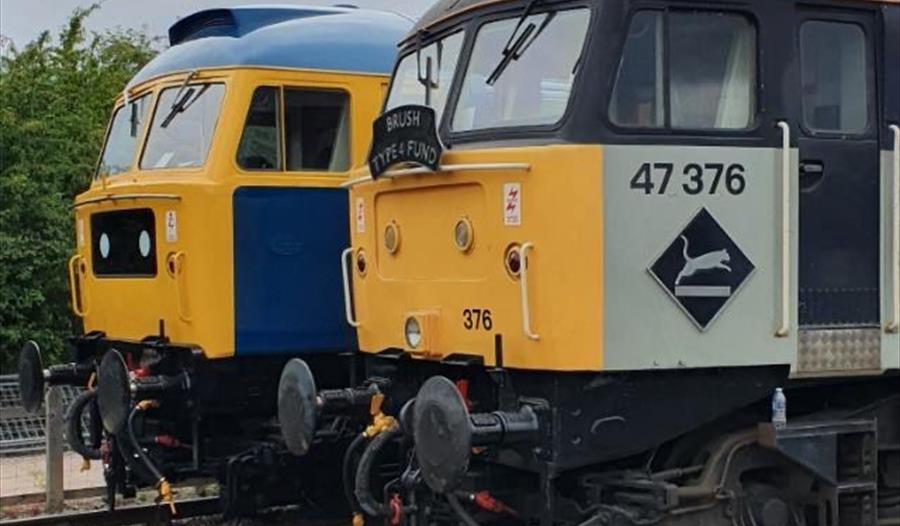
Home resident Brush Type 4 (British Rail Class 47) Co-Co diesel-electric locomotives No's 47105 & 47376 will be 'Doubling Up' on Sunday 7th May on the Gloucestershire Warwickshire Railway, both double-heading and top 'n' tailing train services throughout the day, giving visitors and diesel enthusiasts the full 'Brush' experience. 512 locomotives were built between 1962 and 1968, with construction being carried out at Brush Traction's Falcon Works in Loughborough and British Railways' Crewe Works. With the decline of steam and with diesel-hydraulics falling out of favour – the latter had become synonymous with the Western Region, the Class 47s quickly became the workhorse of the new diesel-electric era. Fitted with powerful 2,750 bhp Sulzer 12LDA28-C engines (which were later de-rated to 2,580 bhp to aid reliability), the Brush Type 4s could be found at home on both freight and passenger services across the railway network. Large numbers of the class took charge of express passenger workings which for many years had been the preserve of prestigious steam locomotives. The locomotives had a route availability of 6 & 7 (RA6/7) and many examples led colourful and interesting lives wearing a myriad of liveries. A number of subclasses were developed over the years to meet the ever changing landscape and needs of British Rail and the Privatisation era which subsequently followed during the mid-1990s. Between 1998 and 2004, Brush Traction rebuilt 33 examples fitting them with EMD 12-645 engines and reconditioned alternators, which became the British Rail Class 57s. Popular with rail operators and enthusiasts alike, over 70 members of the Brush developed Class 47 still exist today, either in active mainline service, long term storage, or in preservation.
The Gloucestershire Warwickshire Railway currently has two members of the class in its home fleet which are both permanent residents.
47105 (D1693) is owned by The Brush Type 4 Fund and was built by Brush Electrical Machines Ltd at Loughborough in 1963. The locomotive was accepted into traffic on the 6th December 1963 as D1693 and operated for the best part of 30 years before being stored unserviceable on the 1st November 1993. 47105 was withdrawn from service on the 13th December 1993 and was purchased by the Brush Type 4 Fund on the 24th January 1994. The locomotive was transported to the GWR in April 1994 and started for the first time in preservation 1 month later. Since then, a considerable amount of work has been carried out on the 47 culminating in the reinstatement of its steam heat boiler – thus making 47105 the first Class 47 to steam since 1987. The locomotive returned to passenger service on the 16th July 2021 following a 10 year overhaul, including a full repaint into British Rail Blue livery.
47376 (D1895) is owned by The Brush Type 4 Fund and was built by Brush Electrical Machines Ltd at Loughborough in 1965. The locomotive was accepted into traffic on the 1st September 1965 as D1895 and operated for the best part of 36 years before its last working on the 8th June 2001. Whilst operating the Southampton freightliner (4O07) in the Oxford area, a piston dropped into the engine sump writing off the Sulzer 12LDA28-C engine - the train was subsequently assisted to Southampton by a Class 57. The Class 47 was purchased by The Brush Type 4 Fund in November 2002 and transported to the GWR in 2003 after receiving a replacement engine at Ashchurch from sister loco No. 47295 - The engine swap took place on 21st June 2003 following 47376's arrival from Southampton Maritime. An interesting fact is that 47376 was the first locomotive to wear the Freightliner Triple Grey livery.
The sound of a 2,580 bhp Sulzer 12LDA28-C diesel engine rumbling through Greet Tunnel is hard to beat, especially when there's two of them!
Sorry, this event has passed
'As perfect and pretty a Cotswold manor house as anyone is likely to see' (Fodor's Great …
Whittington Court is a small Tudor manor house with Jacobean and later additions, set in…
Sezincote is a unique and extraordinary Indian house set amidst the Cotswold Hills. The…
Three generations of women gardeners have designed, planted and sustained this garden. …
Prior's Hall, C. 1480, of former Benedictine Monastery. Library, Religious Vestments,…
Medieval Manor House later transformed into a Tudor Mansion, surrounded by a wide moat…
Kelmscott Manor was the iconic country home of William Morris; poet, designer, craftsman,…
Blenheim Palace is only 8 miles from Oxford, and boasts more than 300 years of history to…
Now Abbey House Gardens is famous worldwide Alan Titchmarsh was right to say, '' The WOW…
Kingston Bagpuize House is open to the public on selected days and for group visits, by…
Step into a creative floral archive where every flower has a story and every sculpture…
Acton Court is believed to be the most ‘original’ Tudor house in Britain. In order to…
Known as the 'Gothic Gem of the Midlands', Arbury Hall has been the ancestral home of the…
The Capability Brown Pleasure Grounds at Wotton, currently undergoing restoration, are…
The most striking feature of Wakefield Walk was the large expanse of Wakefield Lawn.
Recently Viewed
Culture/Heritage
This talk tells the story of how the purchase of an anonymous pocket diary in a London bookshop led…
Talks, Seminiars and Lectures
Lost Houses of Cardiff - Matthew Williams
Cardiff developed very rapidly during the nineteenth…
Museums
£46 Booking required
29 July 10.00 am - 1.00 pm
Historical
The full medieval combat experience. An hour's tuition with a real English longbow, followed by an…
Historical
The sound of a 1750hp English Electric 12CSVT diesel engine rumbling through Greet Tunnel is hard…
Talks, Seminiars and Lectures
Come along to the Bute Park Education Centre for the lecture 'A Welsh Camelot; Cardiff Castle and…

© Visit Heritage 2025. All Rights Reserved

.png)