
There is something irresistible about stepping into a maze. The moment the hedges close behind you, an ordinary garden walk becomes an adventure filled with wrong turns, hidden pathways and the satisfying challenge of reaching the centre.
Britain is home to some of the world’s most fascinating historic mazes, from the celebrated royal maze at Hampton Court Palace to the enormous yew maze at Longleat. Others use their pathways to tell stories of battles, monarchs and mythology, while a few replace traditional hedges with stone, water and the occasional unexpected soaking.
Behind these much-loved visitor attractions lies a history stretching back centuries—a winding journey from ancient sacred labyrinths to the spectacular garden mazes found at Britain’s castles, palaces and country estates today.
What Is the Difference Between a Maze and a Labyrinth?
Although the terms are often used interchangeably, mazes and labyrinths are traditionally quite different.
A classical labyrinth usually has a single winding path leading towards its centre. There are no junctions or dead ends, so the purpose is to follow the route rather than solve a puzzle. Ancient labyrinths were often connected with mythology, ritual and spiritual journeys, symbolising transformation, contemplation and enlightenment.
A maze, by contrast, contains choices. Its paths divide, turn back on themselves and lead unsuspecting visitors towards dead ends. The word maze comes from Middle English and is associated with confusion, bewilderment and delirium—an appropriate description for the delightful disorientation these garden attractions provide.
The History of Hedge Mazes in Britain
By the 16th century, the symbolism of the ancient labyrinth had been transformed into something far more playful. Hedge mazes began appearing in the formal pleasure gardens of wealthy English families, where clipped walls of box, hornbeam and yew created living puzzles.
During the Tudor and early Stuart periods, fashionable gardens reflected the order and symmetry of Renaissance design. Geometric paths, elaborate knot gardens and precisely trimmed hedges demonstrated how nature could be shaped through human skill and imagination.
Mazes offered a rare element of uncertainty within these otherwise carefully controlled landscapes. They provided entertainment for guests, opportunities for competition and secluded pathways that may also have concealed private conversations or romantic meetings.
How Capability Brown Changed Britain’s Historic Gardens
By the 18th century, formal garden design had fallen out of fashion. Celebrated landscape architect Lancelot “Capability” Brown transformed hundreds of country estates, replacing rigid paths and intricate planting schemes with sweeping lawns, serpentine lakes and natural-looking parkland.
Many of Britain’s early hedge mazes disappeared during this period. Their formal lines did not suit Brown’s vision of an idealised natural landscape, and numerous historic examples were removed.
Fortunately, a small number survived, including what is now one of the most famous mazes in Britain.
Hampton Court Maze: Britain’s Most Famous Historic Maze
The Hampton Court Maze was created for William III during the 1690s by royal gardeners George London and Henry Wise. Although Capability Brown later redesigned areas of the palace grounds, the maze survived and remains one of Britain’s greatest horticultural treasures.
Originally planted in hornbeam and later replaced with yew, Hampton Court is a multicursal maze. This means its network contains several possible routes, junctions and dead ends rather than a single path leading directly to the centre.
The maze covers approximately a third of an acre and usually takes around 20 minutes to complete—although particularly determined wrong turns can extend the experience considerably.
More than 300 years after it was planted, visitors can still step inside its high hedges and test their sense of direction in one of the country’s most important surviving historic mazes.
Longleat Hedge Maze: One of Britain’s Largest Mazes
The Longleat Hedge Maze in Wiltshire demonstrates just how ambitious modern maze design can be.
Created by Greg Bright in 1978, the maze extends across approximately 1.48 acres. Its pathways stretch for around 1.69 miles between more than 16,000 carefully maintained yew trees, making it one of the largest hedge mazes in Britain.
Longleat’s magnificent Elizabethan house and surrounding estate provide an impressive setting for this giant green puzzle. Raised wooden bridges offer occasional glimpses across the maze, helping lost visitors understand the scale of the challenge—although spotting the correct route from above is not always as easy as it appears.
The goal is to reach the observation tower at the centre. From there, successful explorers can enjoy a well-earned view over the pathways they have conquered before facing one final challenge: finding the way out.
Blenheim Palace’s Marlborough Maze
Some of Britain’s best mazes do more than confuse their visitors—they tell stories through their design.
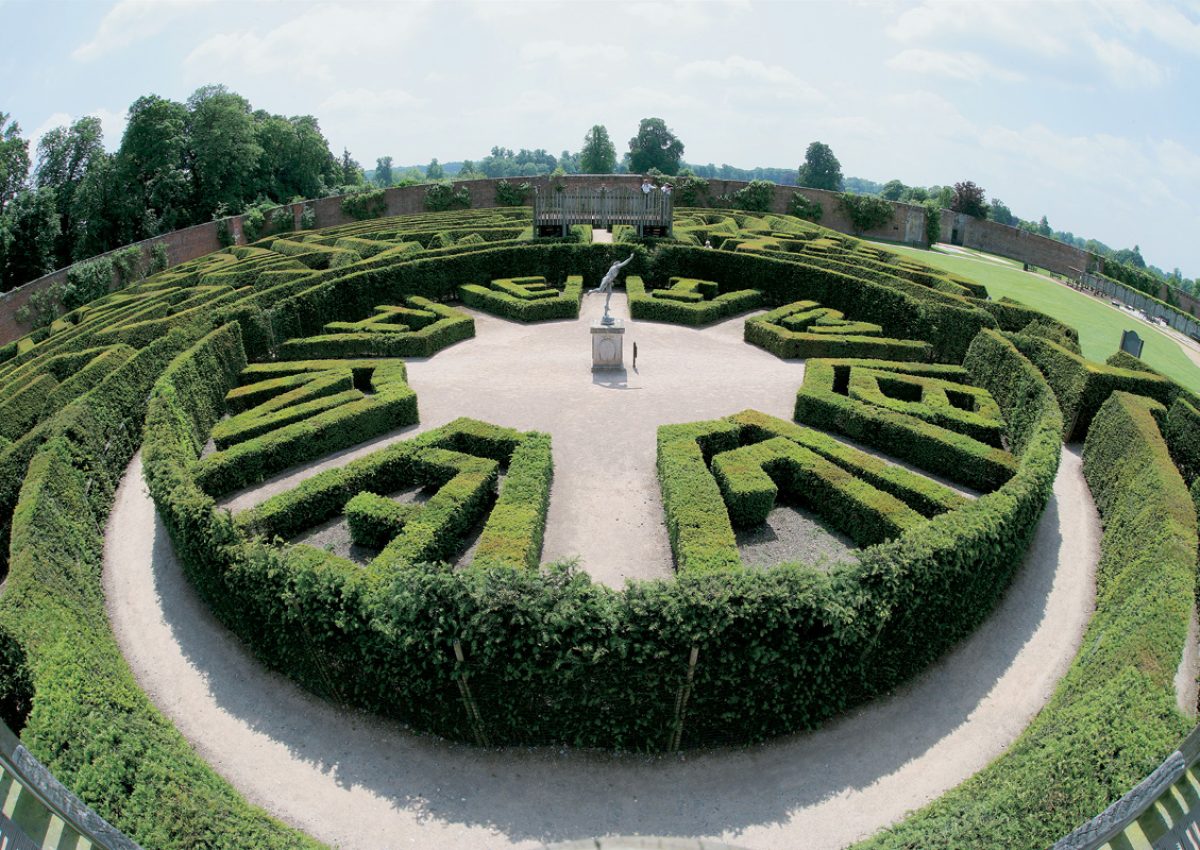
The Marlborough Maze at Blenheim Palace was designed by Randoll Coate and Adrian Fisher. Its layout was inspired by the Panoply of Victory, an elaborate roof carving created by master woodcarver Grinling Gibbons.
When viewed from above, the yew hedges form symbolic images of cannons, flags and banners. These commemorate the military victories of John Churchill, the first Duke of Marlborough, in whose honour Blenheim Palace was built.
The design also includes a hidden “V” for victory, acknowledging Blenheim’s most famous son, Sir Winston Churchill, who was born at the palace in 1874.
From inside, the Marlborough Maze is an entertaining garden puzzle. Seen from above, it becomes an intricate work of landscape art that connects the gardens with the history of Blenheim Palace.
Leeds Castle Maze and Underground Grotto
The maze at Leeds Castle in Kent offers one of the most theatrical maze experiences in Britain.
Its carefully clipped yew hedges form the shape of a queen’s crown when viewed from above, reflecting the castle’s long association with royal women. Often known as the “Castle of Queens”, Leeds Castle was connected with several medieval queens and later became a favoured residence of Henry VIII and Catherine of Aragon.
Visitors who successfully reach the centre discover that the adventure is not over. Instead of emerging into a simple clearing, they descend into an underground grotto decorated with mythical creatures, mysterious faces, alchemical symbols and glittering minerals.
The transition from the bright garden to the shadowy grotto transforms the maze into something resembling a journey through a legend or fairy tale.
Hever Castle Water Maze
Not all of Britain’s famous mazes are created from hedges. At Hever Castle, the childhood home of Anne Boleyn, visitors can attempt a much wetter kind of puzzle.
The Water Maze is set on an island and consists of concentric stepping stones leading towards a stone grotto at the centre. Finding a route across requires a mixture of balance, confidence and luck.
Some of the stones tilt when stepped upon, activating hidden jets of water that can soak unsuspecting visitors. Choosing the wrong route can therefore result in considerably more than a dead end.
Playful, mischievous and especially popular on warm summer days, Hever Castle’s Water Maze proves that an ancient idea can still be reinvented in surprising ways.
Why Britain’s Great Mazes Still Capture Our Imagination
Whether shaped from hornbeam, clipped from yew or constructed using stone and water, Britain’s mazes continue to fascinate visitors of every generation.
Their appeal extends far beyond gardening. A maze gives every visitor a simple story to follow: enter the unknown, overcome the challenge and find the centre. Wrong turns become part of the experience, while reaching the destination brings a small but genuine sense of achievement.
Britain’s historic mazes also reveal changing approaches to landscape design. They connect ancient symbolism with Tudor entertainment, royal garden history and modern creativity, turning the grounds of castles, palaces and country houses into places of discovery.
From the royal hedges of Hampton Court and the towering yews of Longleat to the symbolic pathways of Blenheim and the watery surprises of Hever Castle, Britain’s great mazes remain both puzzles and works of living art.
They remind us that the quickest path is not always the most memorable—and that sometimes getting lost is the best part of the journey.